

Spelling is blending in reverse
To read a CVC word, a child joins sounds together. To spell one, they do the opposite. They hear the whole word, split it into its sounds and write a letter for each sound. Splitting a word into sounds is called segmenting. It appears in the Common Core for kindergarten, where RF.K.2.D covers the first, middle and last sounds of CVC words. It appears again in first grade, where RF.1.2.D covers segmenting one-syllable words into all their sounds.
Step 1: segment out loud
Say a word such as “mop.” The child repeats it, then says each sound: /m/ /o/ /p/. Some children tap a finger once per sound. Keep this oral at first. If the child cannot hear three separate sounds, writing will not help yet.
Step 2: use Elkonin boxes
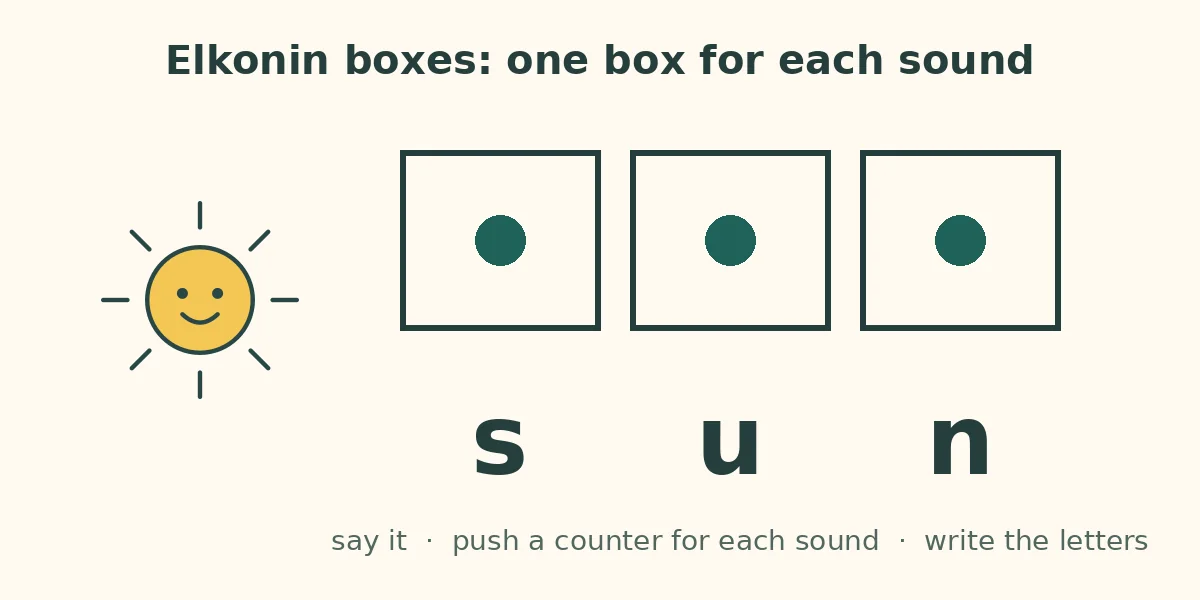
Elkonin boxes, also called sound boxes, are a row of empty squares with one square for each sound in a word. They are named after the Russian psychologist D. B. Elkonin, who developed the method. A CVC word always needs three boxes.
- Show a picture, or say the word.
- The child says the word slowly and pushes one counter into a box for each sound.
- Replace each counter with the letter that spells that sound.
- Read the finished word back, touching each letter.
Our printable Elkonin boxes (PDF) use the same twelve pictures as the picture cards, so the words will already be familiar.
Step 3: write from dictation
Say a word, use it in a short sentence, and say it again: “net, the fish is in the net, net.” The child segments it and writes it. Then check it together, sound by sound. Point out what is right before fixing what is wrong. The worksheet builder prints a read-and-write sheet you can use for dictation if you cover the model words.
A six-week CVC spelling word list
Weeks 1 to 5 each focus on one vowel. Week 6 mixes vowels in the same frame, so the child has to listen for the middle sound instead of assuming it.
| Week | Words |
|---|---|
| Week 1: short a | cat, map, bag, sad, tap, rat, hat, nap |
| Week 2: short i | pig, sit, lid, big, fin, hip, dig, tip |
| Week 3: short o | dog, hot, mop, pot, log, top, dot, hop |
| Week 4: short e | bed, hen, net, leg, red, wet, pen, ten |
| Week 5: short u | sun, cup, bug, mud, rug, hut, tub, nut |
| Week 6: mixed review | bag, beg, big, bug, pan, pen, pin, pun |
Common CVC spelling mistakes
- Missing vowel. “ct” for cat. The child hears the consonants but not the vowel. Stretch the word and ask what sound is in the middle.
- Short e and short i mixed up. “pin” for pen. These vowels sound close, and in parts of the South they sound the same before n. Practice pairs such as bet and bit with the short i and short e lists.
- b and d reversed. This is common in young writers. Keep one clear model of each letter in view.
- c or k? At the start of a CVC word, /k/ is spelled k before e and i, as in kid and kit, and c before a, o and u, as in cat, cot and cup. Longer words have exceptions, but this pattern holds for every CVC word on our lists.
- Adding letters. “catt.” Count the sounds together. Three sounds, three letters.
From spelling words to writing
Once a child can spell single words, ask them to write a short phrase such as “a red hen,” then a sentence such as “The cat sat.” Teach the word the separately, since it is not a CVC word. The trace-and-write worksheet and the cut-and-paste worksheet are gentler starting points for children who are still learning to form letters.