

What blending means
Blending is joining separate sounds into one word. When a child looks at m-a-p, says /m/ /a/ /p/ and then says map, they have blended it. Blending is the main skill in reading CVC words. It is also where many beginners get stuck, because holding three sounds in mind while joining them is hard at first.
The IES practice guide on foundational reading describes two ways to teach blending. In the sounding-out approach, the child says each sound from left to right and then joins them. In the chunking approach, the child joins the first two sounds before adding the next one. Both appear below under the names teachers often use.
Start with oral blending
Before any letters appear, check that the child can blend sounds they hear. Say “/s/ /u/ /n/” with a short pause between sounds and ask what word you said. If this is hard, practice it in games first. A child who cannot blend spoken sounds will struggle to blend printed ones.
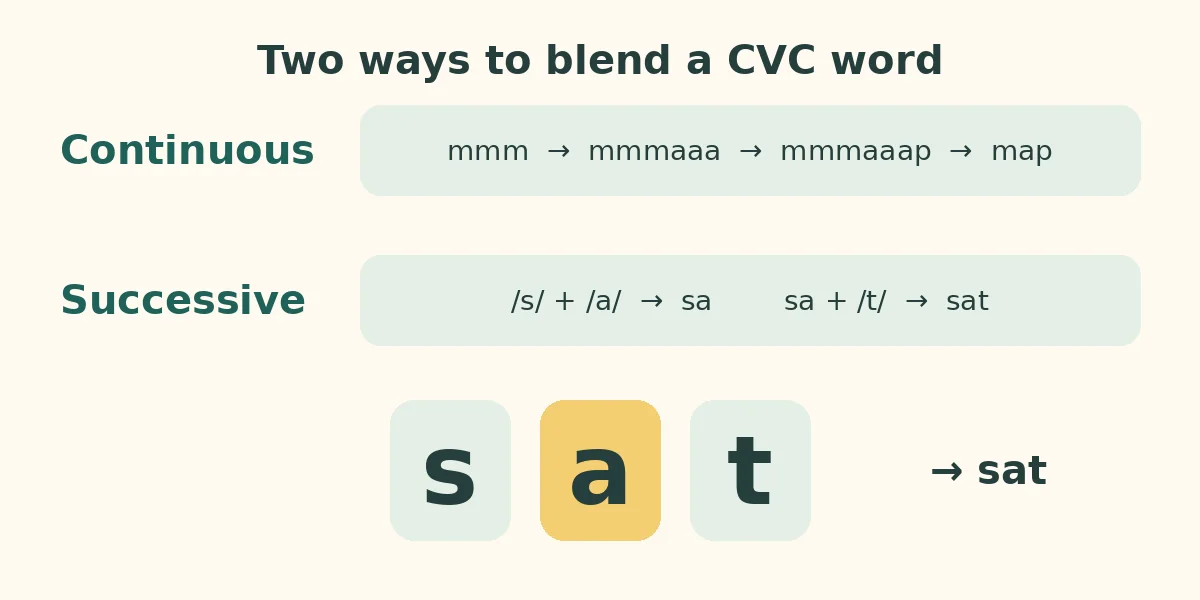
Continuous blending: stretch the sounds
In continuous blending, the child holds each sound and slides straight into the next one without stopping: “mmmaaap.” Stretching removes the gap between sounds, which is where the word often gets lost.
Some sounds can be stretched and some cannot. You can hold /m/, /s/, /f/, /n/, /l/, /r/, /v/, /z/ and every vowel for as long as you like. Sounds such as /b/, /d/, /g/, /k/, /p/ and /t/ are short bursts that cannot be held. So begin with words that start with a sound you can stretch. All of these are in our word bank:
- fan
- lap
- map
- mat
- nap
- rag
- rat
- sad
- sat
- fed
- led
- leg
- let
- men
- met
- net
- red
- fin
- fit
- lid
- lip
- sit
- fog
- log
- lot
- mop
- nod
- not
- sob
- fun
- mud
- mug
- nut
- rub
- rug
- sun
Once these are easy, move to words that start with a quick sound, such as bag, dog and top. With those, the child says the first sound quickly and moves straight on to the vowel.
Successive blending: two sounds, then three
Successive blending is the chunking approach. The child blends the first two sounds, then adds the third:
This helps a child who can say all three sounds but has forgotten the first one by the time they reach the last. Letter tiles make it concrete. Push the first two letters together, read them, then push in the third.
When a child says the sounds but not the word
- Extra “uh” sounds. “Buh-a-tuh” does not blend into bat. Model short, clipped stop sounds, and try a word that starts with a stretchable sound.
- Long pauses between sounds. Ask the child to say the sounds faster each time until they run together.
- A different word comes out. If m-a-p becomes “mop,” point to the vowel and say its sound together. Then read the word again.
- Guessing from the first letter. Cover the word and reveal one letter at a time, from left to right.
- Fine with some vowels, stuck with others. Practice one vowel at a time using the short e or short i list, then mix.
Practice sets, easiest first
| Set | Words | Why this order |
|---|---|---|
| 1. Stretchable start, one vowel | sat, mat, map, fan, nap | Easy to blend, only short a |
| 2. Quick first sound, one vowel | bat, cap, dad, tag, pan | The first sound must be said quickly |
| 3. Same frame, new vowel | bag, beg, big, bog, bug | Only the vowel changes, so it must be read |
| 4. Mixed words | hen, mud, fig, rod, jam | No pattern to lean on |
From blending to reading
Decoding means using letter-sound knowledge to work out a word, and blending is the core of decoding a CVC word. After a child has blended a word correctly several times, they often start to recognize it at a glance. That is the goal. Reading short sentences with CVC words gives the practice a purpose. To check blending without any help from memory, use CVC nonsense words.